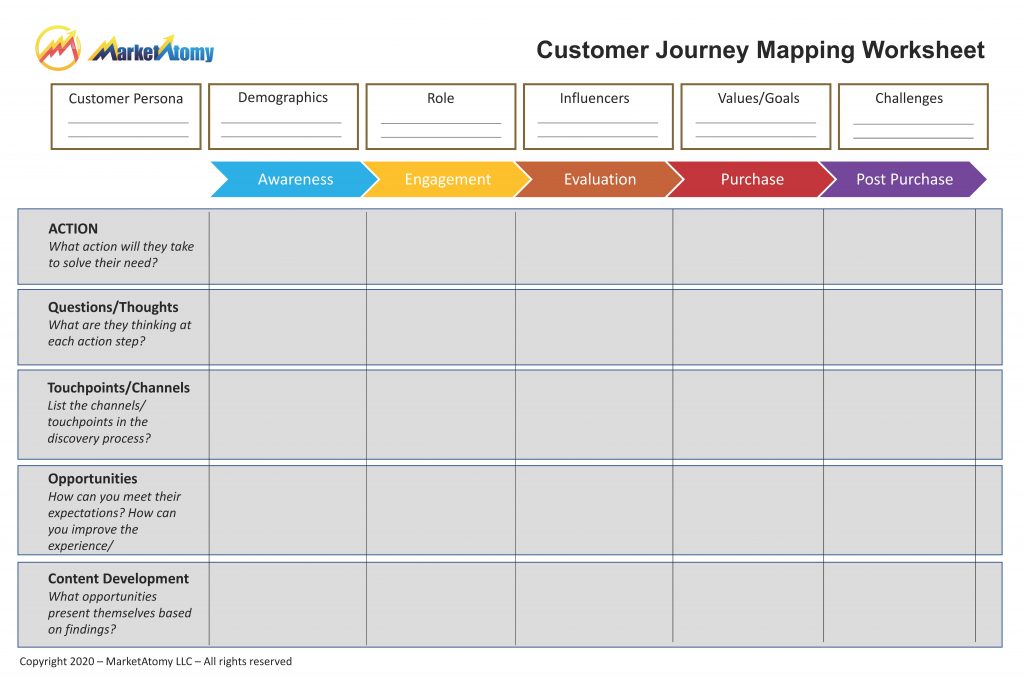
Take a look at the following image map illustrating the Customer Journey process and where touchpoints come into play. Understanding that no two customers are the same and that each brand offering presents a different journey and thus expectation, it’s easy to understand the importance of why this process is critical to building a base of RAVING FANS.

Depending on the business, product, or service which is being mapped, best practices and design may vary. This means you have a great deal of freedom to explore and be creative. The following four steps will help to familiarize you with the process of building a basic touchpoint journey map.
Step 1: Identify your customer persona
What motivates your customers? What are their needs, hesitations, and concerns? Knowing whom you’re talking to is the starting point. Guesses or anecdotes aren’t enough.
Keep in mind that there may be many different personas dependent on when the customer engages with your brand. For example, new customers versus existing customers or experienced vs. inexperienced customers. A customer who is merely fact-finding versus one ready to buy. Each one of these customers will present a different need and expectation within the journey process.
When identifying your customer persona take into consideration HOW, WHERE, and WHY they would be engaging with your brand. This information will be critical in identifying what channels you will utilize in your customer journey mapping process. MarketAtomy offers a separate course on identifying your IDEAL customer called ‘Where’s Waldo.’
Step 2: Uncover behavioral stages and customer goals
Your personas should give you a pretty good idea of the process that customers go through from their first brand engagement to an eventual purchase and subsequent interactions. Monitoring the journey your customers take is critical to understanding behavioral characteristics and expectations at each stage. There are various tools let can be utilized to track the customer journey process. Some examples include Milkymap, Touchpoint, Lucidchart, Google Analytics, and many more.
This may be the most critical—and, in some cases, the most difficult—step when creating a customer journey map. Ask yourself, what do customers want to achieve as they move through each behavioral stage? Again we caution against depending on predetermined assumptions. There are several ways to nail down and get a clear understanding of customer goals.
- Survey/interview different customer groups
- Study customer support emails/transcripts
- Monitor social media posts
- Survey responses
- Monitor customer questions in each phase of interaction with the brand
- Use customer analytics tools like Hotjar, Amplitude or Qualtrics to gather information
- Map Out the Buyer/Customer Touchpoints
A “touchpoint” refers to any time a customer comes into contact with your brand – before, during, or after they purchase something from you. This also includes moments that happen offline/online, through marketing, in person, or over the phone.
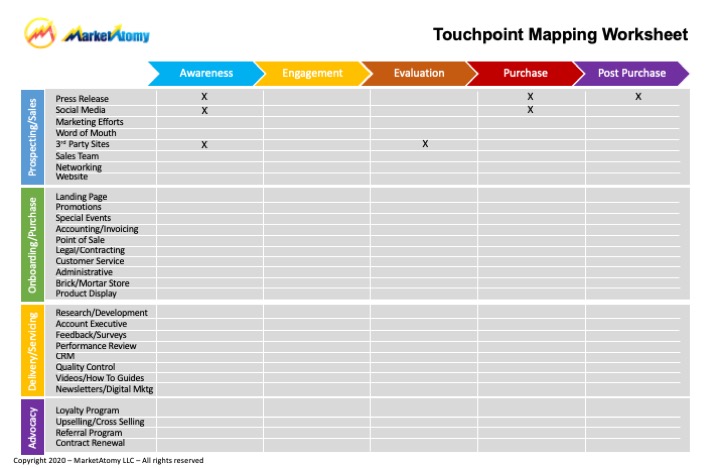
Look at the following example of a touchpoint map to gain a better idea of the touchpoint process.

Some touchpoints may have more impact than others. You’ll want to take all potential touchpoints that occur between your customers and your organization into account. That way, you won’t miss out on any opportunities to listen to your customers and make improvements that will keep them happy.
Step 3: Plot the Touchpoints
This is where the rubber hits the road. It’s time to bring together all your data (both quantitative and qualitative) and look at the big picture to identify potential roadblocks or pain points in the customer journey. The activity of tracking touchpoints builds knowledge and consensus across the entire organization, and the map as proof allows you to create and support better customer experiences. The three main steps to consider when tracking touchpoints are:
1. Uncover the Truth — Study customer behavior and their interactions across different channels, through different touchpoints within distinct phases of the journey. Empathize and understand the customer pain points, by understanding their goals, motives, and issues
2. Plot the Journey — Formulate insights and findings into a journey model dividing it into distinct buying phases (awareness, exploration, sales, onboarding, etc.)
3. Uncover Patterns — Since customer journey maps, with richness and depth, represent key insights into your customer’s complete experience, it uncovers user intent, emotions, motivations, and pain points. Various parts of the user journey help us narrow the problem statement and convert the same into opportunities designers and the team can propose solutions for.
Step 4: Identify Engagement Issues and Fix
There are two ways of looking at the journey process – the Macro and the Micro viewpoints. The MACRO viewpoint looks at the Journey process from an internal operational point of view. What steps are you putting in place to build the Customer Journey in response to touchpoint identification? The goal is to ensure that the customer’s need is sufficiently being met at each channel within the customer journey. When prioritizing and fixing touchpoint issues follow these basic principals:
- Stay true to the brand. Reinforce the brand story by defining the value and educating the customer.
- Eliminate Friction. Deliver moments of delight by delivering at every touchpoint a completely connected end-to-end experience.
- Deliver Outstanding Content. Ensure that your brand has easily accessible content that resonates with customer’s expectations.
- Try producing different kinds of content and sharing it on different channels.
- Don’t be afraid to switch tones when it comes to different channels. Consumers are looking for brands to both inform them and entertain them, and they may respond better to different styles on different platforms.
- When customers reach out with a complaint, try to correct it. If a customer is happy, let them know you appreciate them as a customer.
- Listen to Customers. Sometimes it’s through failure that brands can learn the best way to succeed.
- The more you know about common pain points and how they shape the customer journey is the best way for your brand to create a positive customer experience.
- Identify and improve key touchpoints where transparency can help set better expectations for customers to improve overall satisfaction.
- Utilize A/B testing to gain actionable insights for how to best approach and improve the customer experience at each moment.
- Make each moment remarkable. The experience your brand delivers across every touchpoint is defined by the moment that resonates the most with the customer—whether good or bad.
- Empower your team to engage individually whenever they can to build better brand relationships.
- Deliver a great brand experience, even when it won’t end in conversion.
- Promote programs that build relationships that feel personal. Make sure that upselling aligns with a positive experience where a customer’s problems are being addressed and solved.
At the end of the day, you want to be getting more conversions. So everything you tweak in each customer touchpoint should all be contributing to that one goal.
To do this, ask yourself questions, and interview customers and customer-facing staff.